
S Protein Aptamer
Aptamer-Based SARS-CoV-2 Neutralization – Effective Across Variants Where Antibodies Failed
S Protein Aptamer
Aptamer-Based SARS-CoV-2 Neutralization – Effective Across Variants Where Antibodies Failed
A chemically synthesized DNA aptamer that blocks viral entry across all major SARS-CoV-2 variants – from Wuhan to Omicron – with demonstrated in vivo efficacy and safety.
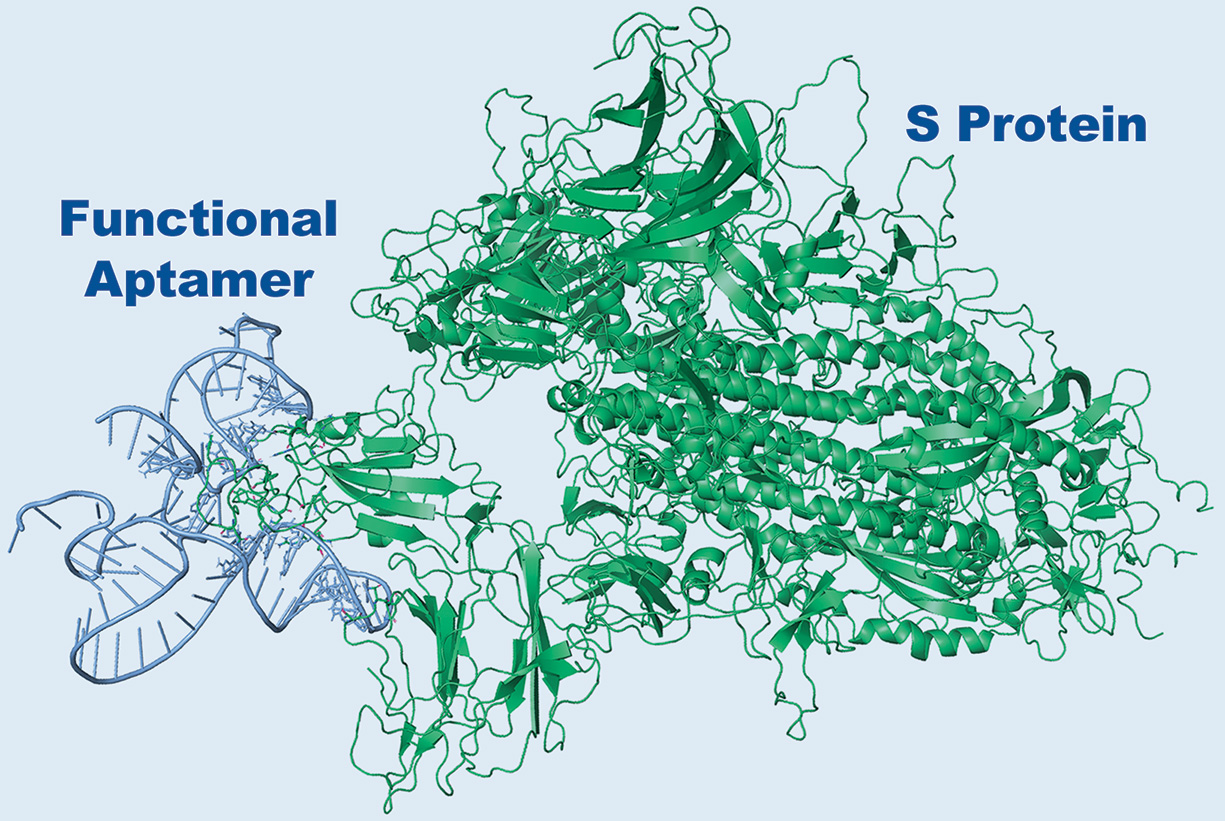
Effective against Wuhan, Delta, Delta Plus, Alpha, Lambda, Mu, and Omicron variants where monoclonal antibodies lost efficacy.
Intratracheal delivery demonstrated efficacy in lung tissue. Safety confirmed in human PBMCs.
Therapeutic candidate, diagnostic reagent, and surface decontamination tool from a single aptamer.
DNA-based aptamer with rapid, scalable production – no cell lines, no cold chain dependency.

The continuous emergence of new SARS-CoV-2 variants of concern created a fundamental problem for existing therapies. Monoclonal antibody treatments — once the frontline therapeutic response — lost efficacy as the virus evolved, particularly against Omicron and subsequent variants. The spike protein mutations that drove immune evasion also rendered antibody binding sites unrecognizable.
This variant instability, combined with the high cost and biological complexity of antibody manufacturing, created an urgent need for a molecular therapeutic approach that could adapt rapidly to viral evolution while maintaining consistent production quality.
We developed a series of single-stranded DNA aptamers through 12 rounds of SELEX (Systematic Evolution of Ligands by Exponential Enrichment) targeting the trimer S protein of SARS-CoV-2. The selection process yielded eight highly enriched aptamer candidates that bind the spike protein and block its interaction with ACE2 receptors — the entry point for viral infection.
How It Works:
The aptamers bind directly to the trimer S protein’s receptor binding domain (RBD), physically preventing the S protein from engaging the ACE2 receptor on host cells. Without this interaction, the virus cannot enter the cell, and infection is blocked at the earliest possible stage.
Key Technical Achievement:
Modified aptamers AYA2012004_L and AYA2012004_L-M1 (created by adding forward/reverse primer sequences and truncation) achieved up to 70% inhibition of virus-like particle (VLP) binding to ACE2 receptors expressed in HEK293T cells.
Unlike monoclonal antibodies that target a single epitope and lose effectiveness when that epitope mutates, our aptamers demonstrated binding and neutralization activity across all major variants of concern:
- Wuhan Original Strain — nM-range binding affinity confirmed by ELISA, flow cytometry, and surface plasmon resonance (SPR)
- Alpha Variant — binding and ACE2 inhibition maintained
- Delta & Delta Plus Variants — binding and ACE2 inhibition maintained
- Lambda Variant — binding and ACE2 inhibition maintained
- Mu Variant — binding and ACE2 inhibition maintained
- Omicron Variant — binding and ACE2 inhibition maintained
This cross-variant efficacy is a direct advantage of the aptamer approach: because the binding interaction is determined by three-dimensional folding rather than linear epitope recognition, aptamers can tolerate mutations that render antibodies ineffective.
Moving beyond in vitro validation, we conducted in vivo experiments delivering AYA2012004_L directly to the lungs via intratracheal intubation. This route of administration targets the primary site of SARS-CoV-2 infection — the respiratory epithelium.
Efficacy:
Intratracheal administration demonstrated functional aptamer delivery to lung tissue with evidence of viral neutralization activity at the site of infection.
Safety:
In vitro safety studies using human peripheral blood mononuclear cells (PBMCs) confirmed that AYA2012004_L does not induce adverse immune activation, supporting a favorable safety profile for continued development.
These combined in vivo efficacy and in vitro safety data established the foundation for advancement into Pre-Clinical Development — the current stage of this program.
The S Protein aptamer platform has applications beyond direct patient treatment:
- Therapeutic Candidate: Direct viral neutralization via respiratory delivery for treatment of COVID-19 infection.
- Diagnostic Reagent: High-affinity, variant-specific binding enables use as a detection tool for viral surveillance and point-of-care testing.
- Surface Decontamination: Aptamer-enhanced decontamination for healthcare facilities, public spaces, and high-risk environments (reference: Aptamer-Enhanced Surface Decontamination publication, April 2025).
This multi-application potential creates multiple commercialization paths from a single aptamer platform, reducing development risk and expanding market opportunity.
__________________________________________
Highly efficacious and safe neutralizing DNA aptamer of SARS-CoV-2 as an emerging therapy for COVID-19 disease
Current Stage: Pre-Clinical Development — the most advanced aptamer program in the Ayass Bioscience pipeline.
Completed: 12 rounds of SELEX selection, in vitro binding and neutralization across 7 variants, VLP inhibition (70%), in vivo intratracheal delivery, PBMC safety profiling.
Next Steps: GMP formulation, formal toxicology studies, and IND-enabling studies for regulatory submission.
Partnership opportunities include: therapeutic co-development for respiratory delivery, diagnostic licensing for point-of-care applications, and decontamination technology licensing for healthcare and public health markets.